白皮书08 · 摘要 · 中文摘要
执行摘要
喀麦隆能够依靠本国人才支撑现代钢铁工业,但前提是培训必须先于炼钢炉启动。拟在克里比分期建设的电弧炉钢厂,一期将创造约500个正规的技术型直接就业岗位(计划),达到100万吨/年的全部设计产能时将达到900至1300个(指示性),其供应链还将为每个直接岗位带动一个至数个额外岗位[S11][S01]。喀麦隆拥有填补这些岗位所需的青年人口、工程师学校、大学技术学院、职业培训中心和法律框架。其欠缺的是:课程中的钢铁冶金内容、工业规模的实践训练、重工业工种的公认认证,以及促使雇主、院校和设备供应商共同开展培训的机制。培养一名炼钢工需要两到三年,培养一名值班经理需要近十年,因此这些缺口必须至少在首炉出钢(计划于2030年下半年)前三年开始弥补,同时招聘或借调有经验的督导人员,在此期间培养喀麦隆接班人。
本页为本章中文摘要;英文全文附于其后,可展开阅读。
本章目录(8)
ES.1 十项主要发现
- 钢厂每吨钢创造的岗位不多,但都是好岗位。根据已发表的案例,直接就业约为每百万吨500至5000个岗位;Cameroon Steel的规划值为一期约每百万吨1670个、满产时约1100个,处于该区间的中部。这些岗位几乎全部是正规的、领取工资的技术岗位,而在喀麦隆,只有5.1%的劳动者在正规私营部门就业[S02][S03][S05][S11][S12]。
- 这些岗位涵盖十一个职业族群和技术教育的各个层次。一期计划人员中约60%为操作工,20%为技术员,10%为工程师,10%为行政和支持人员;约四分之一的岗位属于维修、自动化、质量和安全职能,其技能可迁移至克里比产业集群的其他企业[S11]。
- 喀麦隆的约束在于经验,而非人数。按世界银行估计,每年约有73万青年进入劳动年龄;若2026年人口普查初步统计的2270万人得到确认,这一人数约为55万;而2025年登记的新增就业约为19.7万个。失业率随受教育程度上升,大学毕业生失业率为17.6%,女性大学毕业生为28.2%[S14][S19][S17][S12]。第2章列出常见的三种解释:毕业生排队等待稀缺的正规受薪岗位;高等教育多偏通识而非技术;学校与雇主联系薄弱。雇主提供能把学历转化为能力的正规技术岗位,可同时回应这三方面问题。
- 学校已经存在;欠缺的是钢铁冶金内容、实训车间和产业联系。雅温得国立高等理工学院(ENSPY)、杜阿拉大学的工程师学校和技术学院、恩冈代雷大学的技术学院和矿业学校、新建的埃博洛瓦大学以及三所卓越职业培训中心(CFP d'excellence)覆盖机械、电气、化工和维修等学科,大多位于克里比260公里范围内。目前尚未发现专门的钢铁冶金专业,另有2694名职业培训教师没有任何职业资格证书[S18][S21][S22][S23][S24][S28]。
- 关键缺口在炼钢车间、连铸和班组督导。炉前与连铸操作以及24小时连续生产过程的督导在本地几乎没有基础,需要两到十年才能培养出来;维修、焊接和电气技能虽然存在,但需要按工业标准提升,尤其需要认证。
- 认证是成本最低的杠杆。焊工(ISO 9606-1)和职业健康安全管理(ISO 45001)已有国际标准,第2018/010号法律规定了学徒制、工学交替培训和经验认证。目前欠缺的是由雇主与主管部门共同制定的钢铁职业能力标准,以及据此开展考核的中心[S59][S58][S26]。
- 行之有效的培训模式把学校、工厂和供应商结合起来,并且起步要早。德国双元制、OCP、丹格特(Dangote)和塔塔钢铁(Tata Steel)的企业学院、写入设备合同的供应商培训以及工艺模拟器都指向同一方向:雇主主导、学校认证、供应商转移技术诀窍,人才输送链在投产前数年就已启动[S48][S42][S47][S43][S50]。
- 喀麦隆法律已把激励政策与本地技能和本地供应商挂钩,但优先并不等于能力。2025年投资激励法令要求投资者提交本地技能、本地招聘和本地分包计划,并允许核查承诺履行情况。本地供应商只有经过系统培育才能达到资质要求;丹格特水泥的本地采购占比在2023年至2025年间由72%升至82%,公司称其在此期间投资于供应商培育;汇率变动对该占比的影响未予剥离[S36][S42]。
- 女性是最大的未开发技术人才库。女性占喀麦隆劳动力的43.9%,但在全球钢铁业员工中仅约占11%。要吸引她们,需要找到合法途径,突破1992年《劳动法》对女性在工业领域从事夜班工作的禁令(该禁令与对喀麦隆仍然有效的国际劳工组织第89号公约一致),通过学校和奖学金建立输送渠道,并为男女混合的员工队伍设计设施和行为规范[S14][S51][S33][S69][S73]。
- 安全必须是第一项教授的技能。2021年,南部大区15.4%的劳动者报告在过去一年中发生过工伤,参保者仅占6.6%;而最优秀的钢铁企业每百万工时损失工时伤害不到一起。缩小这一差距需要经认证的关键安全作业授权、全区通用的安全护照以及能在现场发挥领导作用的督导人员[S12][S51]。
ES.2 机遇:持久的技术岗位及其带动的产业集群
Cameroon Steel正在克里比港综合工业区的姆博罗(Mboro)筹建钢铁综合体,设计产能100万吨/年,分期实施;2024年12月30日,总理代表国家元首为项目奠基[S09][S10]。一期额定产能30万吨/年(预计持续产量27万至30万吨/年),以生产钢坯的电弧炉炼钢车间为核心,产品可在轧材(线材和钢筋)与销售给本国轧钢企业的商品钢坯之间灵活调配;这些轧钢企业目前约60%的炉料依赖进口(2023年进口钢坯16.1万吨)。由于钢筋产能已远超需求,一期产量的目标是替代进口并出口至中部非洲经济与货币共同体(CEMAC)市场(见第04号和第09号白皮书)[S11][S08][S76]。根据RC-1.1进度,融资计划于2028年完成,2029年第一季度起开工,2030年下半年首炉出钢,2031年爬产[S11]。根据公司公开的规划数据,一期运营人员约为500个直接岗位,另有约1000个间接岗位;全厂直接岗位为900至1300个;一期建设高峰预计需要600至1000名工人[S11]。图ES.1汇总了这些数值及其状态。
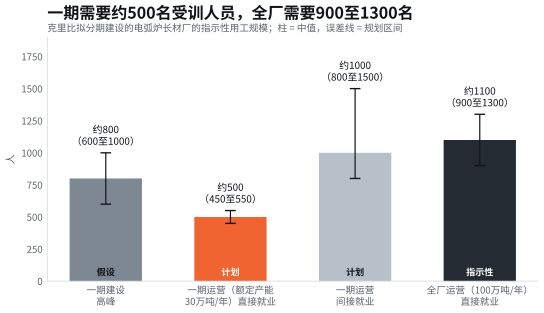
资料来源:Cameroon Steel参考配置RC-1(规划估算),2026年10月10日版(RC-1.1)[S11]。
与约1150万人的劳动力总量相比,这些数字并不大[S14]。钢厂对喀麦隆劳动力市场的价值另有所在:在于它所创造岗位的性质、它留下的技能以及它所带动的产业集群。钢厂需要炼钢工、连铸工和轧钢工,也需要液压和电气技术员、自动化专业人员、焊工、化验分析员、安全员和督导人员,而这些人的技能可以在水泥、铝业、能源、港口和农产品加工等行业通用。2026年2月成立的克里比港工业区股份有限公司(KPIZ S.A.)规划了与矿产出口相关的钢铁、木材、石化、农产品加工和建材等产业集群,预计15年内创造多达15万个直接和间接岗位[S38]。钢铁技能输送链实际上就是整个产业集群的技能输送链。
ES.3 约束:缺的是经验,而非求职者
喀麦隆劳动力市场受过教育的青年求职者众多,而具有工业经验的人才稀缺。只有5.1%的就业人员在正规私营部门工作,86.6%的岗位属于非正规部门;在约四分之一接受过职业培训的成年人中,39.3%是在岗位上学会技能的,大多在小作坊里[S12]。雇主提供的培训比以前更少:提供正式培训的企业比例从2016年的37.6%降至2024年的24.0%[S15]。由此形成自我强化的缺口:正规企业不培训,新进入者便招不到有经验的工人,只能从零开始培训。
克里比所在的南部大区劳动参与率在各调查区域中最高,接受过职业培训的成年人比例也高于平均水平(32.2%,全国为25.0%),但工伤和职业病发生率也最高,参保率则位居最低之列[S12]。新建的埃博洛瓦大学、ENSPY在梅约梅萨拉的分校以及桑梅利马的卓越职业培训中心,首次为该地区提供了工业雇主可以依托的本地技术教育基础[S23][S18][S24]。
ES.4 需要实现的转变
本文分析得出喀麦隆在培养工业技能方面需要实现的五个转变。
从学校主导培训转向雇主主导培训。雇主应确定能力要求、提供导师和设备并录用毕业生;学校负责教学和认证。第2018/010号法律已为学徒制和工学交替培训提供了法律依据[S26];拟分期建设的钢厂正是能够支撑这一机制的规模大、存续期长的雇主。
从学历转向经认证的能力。钢铁职业能力标准、焊工和关键安全作业的国际证书以及设备操作的供应商证书,应作为国家学历之上的补充,使能力看得见、可携带。
从录用后培训转向投产前培训。人才输送链须在首炉出钢前约三年启动,对2030年下半年首炉出钢而言即须在2027年、融资交割之前启动:工程师最先招聘并派往在产钢厂实习;维修和轧钢工种的双元制学徒培训提前30个月开始;操作工提前18个月起接受模拟器培训;供应商培训须在每份设备合同中明确规定、加以考核并据此付款。
从优先采购转向供应商培育。只有在克里比港综合工业区全区范围内帮助喀麦隆供应商逐级完成登记、资质审核、试点订单、辅导和准入,并如实计量本地成分,本地成分才能放大就业效应。
从男性员工队伍转向男女混合队伍,从合规转向安全文化。新建工厂可以从一开始就把包容和安全纳入设计:为女性配备设施和排班安排,为所有承包商制定行为准则,实行经认证的关键安全作业授权,并培训督导人员在现场发挥领导作用。
ES.5 示意性人力规划
第9章的人力规划把一期约500人的计划人员分配到各工艺区域和职能。其中约一半(240个岗位),即炼钢、连铸、维修和工程技术骨干,须在首炉出钢前18至36个月进入培训;其余岗位在首炉出钢前6至18个月开始培训,其中堆场、精整、发运和支持部门约140个岗位可在首炉出钢前的最后一年内完成招聘和培训,主要来自南部大区。50名工程师必须最先招聘,因为他们将成为培训师、督导人员和外籍专家的接替者。根据RC-1.1进度,首炉出钢在2030年下半年,技能伙伴关系和毕业生招聘须于2027年上半年启动,首批学徒于2028年初入学。这两项均早于计划于2028年完成的融资交割:其费用将由Cameroon Steel和拟设立的产业集群培训基金承担风险先行投入,并按RC-1.1进度确定规模[S11]。Cameroon Steel的目标是到运营第五年,约90%(85%至95%区间)的运营人员为喀麦隆籍[S11],每个外籍岗位从一开始就配备一名指定的喀麦隆接替者。以后各期的人员应主要由上一期培养的人员担任,途径包括内部晋升、每年招收学徒以及由喀麦隆培训师授课。
ES.6 十二项行动
第10章提出十二项行动,并明确牵头方、合作方、时间安排和指标。其中三项是基础性措施,可在一年内落实:
- 建立克里比钢铁和重工业技能伙伴关系,由就业与职业培训部(MINEFOP)召集,教育和工业主管部门、KPIZ S.A.、雇主、工会和培训机构参加。
- 设立产业集群培训基金,资金来自2023年开征的外籍劳工劳动合同签证费的一部分、雇主出资以及开发性金融机构的支持,并部分按成果向培训机构付款[S31][S29]。
- 对学徒制给予税收激励,依据第2018/010号法律关于税收激励的规定,并与经认证的产出挂钩[S26]。
其余九项包括:与ENSPY、杜阿拉国立高等理工学院(ENSPD)、杜阿拉高等技术学院(ISTD)、国立高等技术师范学院(ENSET)和埃博洛瓦大学共同设计课程;双元制学徒计划;钢铁职业能力标准和考核中心;设备合同中的培训条款;女性进入重工业职业的通道;全区通用的安全护照和承包商标准;全区供应商培育和本地成分报告;在中学开展职业宣传;以及每年公布人力指标。
ES.7 本文的阅读方法
在英文版和法文版全文中,第1至3章说明需求(钢厂创造哪些岗位)和供给(喀麦隆的劳动力市场和教育体系);第4至8章分析缺口及其弥补途径:技能与认证、培训模式、本地成分与供应商培育、女性参与和安全文化;第9章汇总为示意性人力规划,第10章提出建议,第11章列出尚不清楚的问题。附录A说明方法和假设,附录B为术语表,附录C列出全部来源,附录D列出各图数据。本中文摘要版对上述各章作了摘要。
文中每个数字都带有来源标记,图表中还注明状态:来源、推算、假设或示意。Cameroon Steel项目的人员数字是其参考配置中的公开规划值,分别标注为计划、指示性、假设或目标;它们不是承诺,将随工程设计和分期安排的确定而细化。生成图像标注为“示意图”,并不描绘项目、员工或任何真实人物。
利益声明。本文由正在克里比筹建钢铁厂的Cameroon Steel发布,旨在为公共讨论提供参考;其分析独立于任何商业要约,所有数据均注明来源或标明其状态。
英文全文 11分钟 · 2515词Executive summary
Cameroon can staff a modern steel industry with its own people, but only if the training starts before the furnace does. A phased electric arc furnace (EAF) steelworks at Kribi would create about 500 direct, formal and technical jobs in its first phase (planned) and 900 to 1,300 at its full design capacity of 1 Mtpa (indicative), with a supply chain that supports one to several further jobs for each of them [S11][S01]. Cameroon has the young people, the engineering schools, the institutes of technology, the vocational centres and the legal framework to fill those jobs. What it lacks is steelmaking content in its curricula, industrial-scale practice, recognised certification for heavy-industry trades, and a mechanism that makes employers, schools and equipment suppliers train together. Because a melter takes two to three years to form and a shift manager closer to ten, those gaps must start to close at least three years before first steel, planned for the second half of 2030, with experienced supervisors recruited or seconded while Cameroonian successors are formed.
ES.1 Ten findings
- A steelworks creates few jobs per tonne, but good ones. Direct employment ranges from about 500 to 5,000 jobs per million tonnes across published cases; Cameroon Steel’s planning values, about 1,670 per million tonnes in the first phase and about 1,100 at full capacity, sit in the middle of that range. Almost all are formal, salaried and technical, in a country where only 5.1% of workers hold a formal private-sector job [S02][S03][S05][S11][S12].
- The jobs span eleven occupational families and every level of technical education. About 60% of the planned first-phase workforce are operators, 20% technicians, 10% engineers and 10% administrative and support staff; about a quarter of all posts are in maintenance, automation, quality and safety functions whose skills transfer to the rest of the Kribi industrial cluster [S11].
- Cameroon’s constraint is experience, not people. About 730,000 young people reach working age every year on World Bank estimates, or about 550,000 if the provisional 2026 census count of 22.7 million is confirmed, while about 197,000 new jobs were recorded in 2025. Unemployment rises with education, to 17.6% among graduates and 28.2% among women graduates [S14][S19][S17][S12]. Chapter 2 sets out the three explanations usually advanced: graduates queue for scarce formal, salaried jobs; much higher education is general rather than technical; and links between schools and employers are weak. An employer can act on all three by offering formal technical jobs in which schooling becomes competence.
- The schools exist; steelmaking content, workshops and industry links do not. ENSPY (École nationale supérieure polytechnique de Yaoundé), the University of Douala’s engineering school and institute of technology, the University of Ngaoundéré’s institute and mining schools, the new University of Ebolowa and three vocational centres of excellence cover mechanical, electrical, chemical and maintenance disciplines, most within 260 km of Kribi. No programme dedicated to steelmaking has been identified, and 2,694 vocational trainers lack a professional diploma [S18][S21][S22][S23][S24][S28].
- The critical gaps are in the melt shop, the caster and supervision. Furnace and casting operation and the supervision of a 24-hour process have almost no local base and take two to ten years to form; maintenance, welding and electrical skills exist but need industrial upgrading and, above all, certification.
- Certification is the cheapest lever. International standards exist for welders (ISO 9606-1) and safety management (ISO 45001), and Law No. 2018/010 provides for apprenticeship, work-linked training and validation of experience. What is missing is a set of steel-occupation competence standards written by employers with the ministry, and a centre to test against them [S59][S58][S26].
- Training models that work combine school, plant and supplier, and start early. Germany’s dual system, the corporate academies of OCP, Dangote and Tata Steel, vendor training written into equipment contracts and process simulators all point the same way: employers lead, schools certify, suppliers transfer know-how, and the pipeline opens years before production [S48][S42][S47][S43][S50].
- Cameroon’s law now ties incentives to local skills and suppliers, but preference is not capability. The 2025 investment-incentives ordinance requires a local-skills, local-hiring and local-subcontracting programme and allows commitments to be verified. Local suppliers will qualify only through structured development. Dangote Cement’s local procurement share rose from 72% to 82% between 2023 and 2025, a period in which it reports investing in supplier development; the effect of exchange-rate changes on the shares is not separated [S36][S42].
- Women are the largest untapped pool of technical talent. Women are 43.9% of Cameroon’s labour force but about 11% of steel workforces worldwide. Reaching them requires a lawful route past the 1992 Labour Code’s ban on women’s night work in industry, which mirrors ILO Convention No. 89, still in force for Cameroon; a pipeline through schools and scholarships; and facilities and conduct rules designed for a mixed workforce [S14][S51][S33][S69][S73].
- Safety must be the first skill taught. In 2021, 15.4% of workers in the South Region reported a work accident in the previous year and only 6.6% were insured; the best steel companies run below one lost-time injury per million hours. Closing that gap requires certified safety-critical authorisations, a common safety passport for the zone and supervisors who lead in the field [S12][S51].
ES.2 The opportunity: durable, technical jobs and a cluster around them
Cameroon Steel is developing a steel complex at Mboro, in the Kribi industrial-port zone, with a design capacity of 1 Mtpa built in phases; its foundation stone was laid on 30 December 2024 by the Prime Minister, representing the Head of State [S09][S10]. The first phase, of 0.3 Mtpa nameplate capacity (expected sustained output 270,000 to 300,000 t a year), centres on an EAF melt shop that makes billets, with output flexible between rolled products (wire rod and reinforcing bar) and merchant billets for Cameroon’s re-rollers, which import about 60% of their charge (161,000 t of billets in 2023). Because rebar capacity is already well above demand, Phase 1 tonnage is aimed at replacing imports and at exports within CEMAC (White papers 04 and 09) [S11][S08][S76]. On the RC-1.1 schedule, financing is planned for 2028, works from the first quarter of 2029, first heat in the second half of 2030 and ramp-up in 2031 [S11]. The company’s public planning figures put the first-phase operating workforce at about 500 direct jobs, with about 1,000 indirect jobs, and the full works at 900 to 1,300 direct jobs; the construction of the first phase is expected to employ 600 to 1,000 workers at its peak [S11]. Figure ES.1 summarises these values with their status.
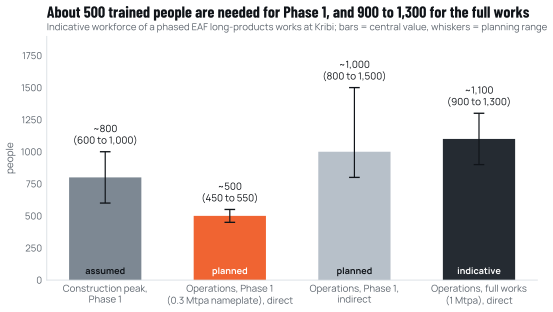
Source: Cameroon Steel reference configuration RC-1 (planning estimate), edition 10 October 2026 (RC-1.1) [S11].
These numbers are modest against a labour force of about 11.5 million [S14]. The value of a steelworks for Cameroon’s labour market lies elsewhere: in the kind of jobs it creates, in the skills it leaves, and in the industrial cluster it anchors. A steelworks needs melters, casters and mill operators, but it also needs hydraulics and electrical technicians, automation specialists, welders, laboratory analysts, safety officers and supervisors, whose skills are portable across cement, aluminium, energy, ports and agro-industry. The Kribi Port Industrial Zone (KPIZ), created in February 2026, plans clusters in steel linked to mineral exports, wood, petrochemicals, agro-industry and construction materials and expects up to 150,000 direct and indirect jobs over 15 years [S38]. A steel skills pipeline is, in practice, a cluster skills pipeline.
ES.3 The constraint: experience, not candidates
Cameroon’s labour market has an abundance of young candidates with schooling and a scarcity of people with industrial experience. Only 5.1% of workers are employed in the formal private sector, 86.6% of jobs are informal, and of the quarter of adults who have followed vocational training, 39.3% learned on the job, mostly in small workshops [S12]. Employers train less than they did: the share of firms offering formal training fell from 37.6% in 2016 to 24.0% in 2024 [S15]. The result is a self-perpetuating gap: formal firms do not train, so newcomers cannot recruit experienced workers, so they must train from scratch.
The South Region, which hosts Kribi, has the highest labour-force participation of any survey region and an above-average share of adults with vocational training (32.2% against 25.0% nationally), but also the highest rates of work accidents and occupational disease, and among the lowest insurance cover [S12]. Its new university at Ebolowa, the polytechnic annex at Meyomessala and the vocational centre of excellence at Sangmélima give it, for the first time, a local base of technical education on which an industrial employer can build [S23][S18][S24].
ES.4 What must change
The paper’s analysis leads to five shifts in how industrial skills are built in Cameroon.
From school-led to employer-led training. Employers should define competences, provide tutors and equipment and hire graduates; schools should teach and certify. Law No. 2018/010 already provides the legal basis for apprenticeship and work-linked training [S26]; a phased steelworks is the kind of employer, large and long-lived, that can anchor it.
From diplomas to certified competence. Steel-occupation competence standards, international certificates for welders and safety-critical tasks, and vendor certificates for equipment operation should sit on top of national diplomas, so that competence is visible and portable.
From training after hiring to training before production. The pipeline must open about three years before first steel, which for a first heat in the second half of 2030 means 2027, before financial close: engineers recruited first and placed in operating plants, a dual apprenticeship for maintenance and mill trades started 30 months ahead, operators trained on simulators from 18 months ahead, and vendor training specified, measured and paid for in every equipment contract.
From preference to supplier development. Local content will multiply jobs only if Cameroonian suppliers are helped up a ladder of registration, qualification, pilot orders, coaching and approval, at the scale of the KPIZ zone, and if local content is measured honestly.
From a male workforce to a mixed one, and from compliance to a safety culture. A new works can design inclusion and safety in from the start: facilities and rosters for women, a code of conduct for all contractors, certified safety-critical authorisations and supervisors trained to lead in the field.
ES.5 An illustrative workforce plan
The workforce plan in Chapter 9 allocates the planned first-phase workforce of about 500 across process areas and functions. About half of it, the melt-shop, caster, maintenance and engineering cadres (240 posts), must be in training 18 to 36 months before first steel; the rest 6 to 18 months ahead, including about 140 posts in the yard, finishing, dispatch and support that can be recruited and trained in the final year before first steel, largely from the South Region. The 50 engineers must be recruited first because they will become trainers, supervisors and successors to expatriate specialists. On the RC-1.1 schedule, with first heat in the second half of 2030, the skills partnership and graduate recruitment start in early to mid 2027 and the first apprenticeship intake in early 2028. Both fall before financial close, planned for 2028: they would be funded at risk by Cameroon Steel and the proposed cluster fund, and sized to the RC-1.1 schedule [S11]. Cameroon Steel’s objective is that about 90% of its operating workforce, within a range of 85 to 95%, be Cameroonian by the fifth year of operation [S11], with each expatriate post paired from the start with a named Cameroonian successor. Each later phase should be staffed largely by people trained in the phase before it, through promotion, annual apprenticeship intakes and Cameroonian trainers.
ES.6 Twelve actions
Chapter 10 sets out twelve actions with leads, partners, timing and indicators. Three are enablers that can be put in place within a year:
- A Kribi steel and heavy-industry skills partnership convened by the Ministry of Employment and Vocational Training with the education and industry ministries, KPIZ, employers, unions and training providers.
- A cluster training fund combining part of the foreign-worker visa levy introduced in 2023, employer contributions and development-finance support, paying providers partly on results [S31][S29].
- A fiscal incentive for apprenticeships, using the provision for tax incentives in Law No. 2018/010 and linked to certified outputs [S26].
The other nine cover curricula co-designed with ENSPY, ENSPD, the ISTD, ENSET and the University of Ebolowa; a dual apprenticeship programme; steel-occupation competence standards and a test centre; training clauses in equipment contracts; women’s access to heavy-industry careers; a common safety passport and contractor standard for the zone; zone-wide supplier development and local-content reporting; careers outreach in schools; and annual publication of workforce indicators.
ES.7 How to read this paper
Chapters 1 to 3 describe the demand (what jobs a steelworks creates) and the supply (Cameroon’s labour market and education system). Chapters 4 to 8 examine the gaps and the means to close them: skills and certification, training models, local content and supplier development, women’s participation and safety culture. Chapter 9 brings these together in an illustrative workforce plan, Chapter 10 sets out recommendations and Chapter 11 lists what is not yet known. Annex A explains methods and assumptions, Annex B defines terms, Annex C lists every source and Annex D prints the data behind every chart.
Every number in the paper carries a source marker and, in figures and tables, a status label: sourced, derived, assumed or illustrative. Workforce figures for Cameroon Steel’s project are public planning values from its reference configuration, labelled planned, indicative, assumed or objective; they are not commitments and will be refined as engineering and phasing are confirmed. Generated images are labelled "Illustrative view" and do not depict the project, its staff or any real person.
Statement of interest. This paper is published by Cameroon Steel, which is developing a steelworks at Kribi. It is written to inform public debate; its analysis is independent of any commercial offer, and every figure is sourced or labelled with its status.
本章引用的资料来源
方括号内的标记对应以下来源(按原文语言列出),完整列表见附录。 完整来源列表
- S11Cameroon Steel reference configuration RC-1 (planning estimate), edition 10 October 2026 (RC-1.1). Cameroon Steel,2026年10月10日.按标题和日期引用
- S14World Development Indicators, Cameroon: population by age, labour force, ILO modelled labour indicators, Human Capital Index. World Bank,更新:2026年10月8日.api.worldbank.org/v2/country/CMR/indicator/SL.UEM.TOTL.ZS?format=json
- S19Cameroun: bouclage du 4e RGPH, 22,7 millions d’habitants recensés (provisional field count). Journal du Cameroun,2026年10月5日.fr.journalducameroun.com/cameroun-bouclage-du-4e-rgph-227-millions-dha…
- S12Troisième enquête sur l’emploi et le secteur informel (EESI3), phase 1: enquête emploi, rapport principal (2021 data; Tables 2.9, 3.7, 3.24 and 4.1 are cited). Institut national de la statistique (INS), Cameroon,2023年11月(文件:2025年7月).ins-cameroun.cm/wp-content/uploads/2025/07/EESI3_Rapport-principal_Emp…
- S15Enterprise Surveys indicator: firms offering formal training (% of firms), Cameroon and Sub-Saharan Africa. World Bank,更新:2026年10月8日.api.worldbank.org/v2/country/CMR/indicator/IC.FRM.TRNG.ZS?format=json
- S02European Steel in Figures 2025. EUROFER,2025年6月.eurofer.eu/assets/publications/brochures-booklets-and-factsheets/europ…
- S03Nucor to build new rebar micro mill in North Carolina. Nucor Corporation,2022年4月7日.nucor.com/news-release/nucor-to-build-new-rebar-micro-mill-in-north-ca…
- S05Devki opens Sh50bn steel plant in Kwale. Capital FM Kenya,2022年11月20日.capitalfm.africa/devki-opens-sh50bn-steel-plant-in-kwale/
- S17Retombées: plus de 197 000 emplois créés en 2025. Cameroon Tribune,2026年5月8日.cameroon-tribune.cm/article.html/76537/en.html/details_2
- S18École nationale supérieure polytechnique de Yaoundé: presentation (created in 1971), departments and 2026 to 2027 entrance competition (Meyomessala annex). ENSPY.polytechnique.cm/
- S21Institut supérieur de technologie de Douala (ISTD): departments and key figures. ISTD, Université de Douala.iut-dla.cm/
- S22Établissements; Institut universitaire de technologie (identification sheet). Université de Ngaoundéré.univ-ndere.cm/fr/etablissements/
- S23Cameroun: les nouveaux responsables de l’université d’Ebolowa prennent fonctions. Journal du Cameroun,2024年7月23日.fr.journalducameroun.com/cameroun-les-nouveaux-responsables-de-luniver…
- S24Cameroon inaugurates 3 excellence training centres of FCFA 24 billion built by South Korea. Business in Cameroon,2016年12月20日.businessincameroon.com/cooperation/2012-6783-cameroon-inaugurates-3-ex…
- S28Centres de formation professionnelle: 2 694 formateurs exercent sans diplôme au Cameroun. EcoMatin,2026年1月30日.ecomatin.net/centres-de-formation-professionnelle-2-694-formateurs-exe…
- S59ISO 9606-1:2012, Qualification testing of welders: fusion welding, Part 1: Steels. International Organization for Standardization,2012年.iso.org/standard/54936.html
- S58ISO 45001:2018, Occupational health and safety management systems: requirements with guidance for use. International Organization for Standardization,2018年3月.iso.org/standard/63787.html
- S26Loi n° 2018/010 du 11 juillet 2018 régissant la formation professionnelle au Cameroun (text). Republic of Cameroon (reproduced by Cameroun24),2018年7月11日.cameroun24.net/article/46391-loi-n2018-010-du-11-juillet-2018-regissan…
- S48Vocational training (theme page and press release of 12 April 2023 on new apprenticeship contracts in 2022). Federal Statistical Office of Germany (Destatis).destatis.de/EN/Themes/Society-Environment/Education-Research-Culture/V…
- S42Annual Report and Accounts 2025. Dangote Cement Plc,2026年6月.cement.dangote.com/wp-content/uploads/2026/06/Dangote-Cememt-Plc-2025-…
- S47OCP SA, UM6P Project (project summary: ownership, Benguerir campus, enrolment). Multilateral Investment Guarantee Agency (MIGA), World Bank Group,2021年.miga.org/project/ocp-sa-um6p-project
- S43Tata Steel’s SNTI celebrates century of skilling industrious workforce (press release). Tata Steel,2021年11月1日.tatasteel.com/newsroom/press-releases/india/2021/tata-steel-s-snti-cel…
- S50steeluniversity: learning for the steel industry (simulations, courses, safety videos). World Steel Association.steeluniversity.org/
- S36Ordonnance n° 2025/002 du 18 juillet 2025 fixant les incitations à l’investissement en République du Cameroun (certified copy). Presidency of the Republic (copy published by LEGECAM),2025年7月18日.legecam.cm/wp-content/uploads/2025/08/ordonnance_n_2025_002_du_18_07_2…
- S51Sustainability indicators (2025 report; 2022 to 2024 data). World Steel Association.worldsteel.org/wider-sustainability/sustainability-indicators/
- S33Loi n° 92/007 du 14 août 1992 portant Code du travail. Republic of Cameroon (FAOLEX copy),1992年8月14日.faolex.fao.org/docs/pdf/cmr198304.pdf
- S69Night Work (Women) Convention (Revised), 1948 (No. 89): text and key information (interim status; may be denounced 27 Feb 2031 to 27 Feb 2032). International Labour Organization (ILO), NORMLEX.normlex.ilo.org/dyn/nrmlx_en/f?p=NORMLEXPUB:12100:0::NO::P12100_ILO_CO…
- S73Ratifications for Cameroon (51 conventions; No. 89 ratified 25 May 1970 and No. 155 ratified 1 Oct 2021, both in force). ILO, NORMLEX.normlex.ilo.org/dyn/nrmlx_en/f?p=NORMLEXPUB:11200:0::NO::P11200_COUNTR…
- S09Kribi: le Premier ministre, chef du gouvernement est là. Cameroon Tribune,2024年12月30日.cameroon-tribune.cm/article.html/68499/fr.html/details_2
- S10Industrialisation: la voie royale de l’émergence. Cameroon Tribune,2025年1月2日.cameroon-tribune.cm/article.html/68558/fr.html/details_2
- S08Production: les acteurs en présence. Cameroon Tribune,2026年5月11日.cameroon-tribune.cm/article.html/76600/fr.html/details_2
- S76UN Comtrade public API: Cameroon (reporter 120), imports of HS 7207 (semi-finished iron and steel, including billets), 2023. United Nations Statistics Division.comtradeapi.un.org/public/v1/preview/C/A/HS?reporterCode=120&period=20…
- S38Zone industrialo-portuaire de Kribi (KPIZ): jusqu’à +8 points de croissance et 150 000 emplois attendus sur 15 ans. Investir au Cameroun,2026年3月4日.investiraucameroun.com/gestion-publique/0403-23163-zone-industrialo-po…
- S31Cameroun: en 2023, l’État n’a collecté que 5 milliards de recettes auprès des travailleurs étrangers. EcoMatin,2024年1月26日.ecomatin.net/cameroun-en-2023-letat-na-collecte-que-5-milliards-de-rec…
- S29Cameroun: vers la création d’un fonds national pour financer la formation professionnelle. EcoMatin,2024年12月10日.ecomatin.net/cameroun-vers-la-creation-dun-fonds-national-pour-finance…
- S01Economic and social impact of the global steel industry (infographic). World Steel Association and Oxford Economics,2019年5月.worldsteel.org/wp-content/uploads/Steel-social-and-economic-impact.pdf
引用本章
Cameroon Steel(2026)。只要培训先于炼钢炉启动,喀麦隆就能为本国钢铁工业培养所需人才(中文摘要版)。白皮书08,摘要:执行摘要。CS-WP-08。https://www.cameroon-steel.com/zh/library/skills-for-steel/executive-summary/
来源