但法律优先不能创造有能力的供应商。缺口通常在健康安全体系、质量保证和文件、特定工作的技术能力以及营运资金四个方面。供应商培育应逐级推进:登记、资质审核、低风险试点订单、辅导与加快付款、框架合同准入,最终向园区和区域内其他行业供货。丹格特水泥的本地采购占比从2023年的72%升至2025年的82%,本地采购额达1.719万亿奈拉;公司称其在此期间投资于供应商培育,但汇率变动对该占比的影响未予剥离[S42]。喀麦隆钢铁和金属加工企业约有5000名员工、营业额约5000亿中非法郎[S08]。服务和现场工程首年即可大部分本地化;维修、机加工和部分消耗品可在五年内跟进。本地成分应按四项指标如实计量:在喀麦隆注册供应商的采购额、喀麦隆资本中小企业和南部大区企业的采购额、本地增加值以及供应商能力成果。
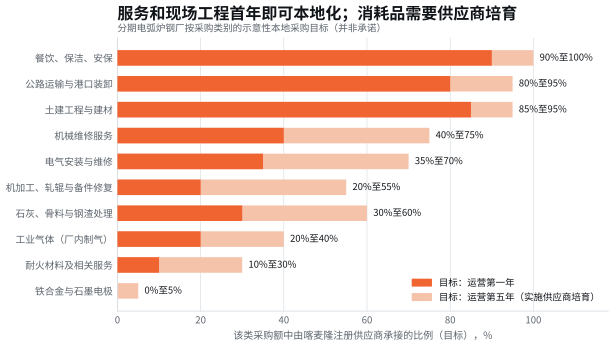
资料来源:Cameroon Steel分析。所示为目标,并非承诺或预测;方法见英法文版附录A。
英文全文 11分钟 · 2617词Local content multiplies a steelworks’ jobs only if suppliers are developed, not merely preferred
Most of the jobs a steelworks supports are outside its fence, in the firms that build it, maintain it, feed it, transport its products and serve its workers. Cameroon’s law now pushes investors towards local hiring and local suppliers: the 2025 investment-incentive ordinance makes a local-skills, local-hiring and local-subcontracting programme a condition of eligibility, and the 2023 Mining Code sets detailed local-content obligations for the ore supply chain [S36][S35]. Legal preference alone, however, does not create capable suppliers. The evidence from other African heavy industries is consistent with local procurement rising where buyers invest in suppliers’ capabilities, step by step, and measure the result, although no published case isolates the effect of that investment. For a Kribi steelworks, services and site works can be largely local from the first year; maintenance, machining and some consumables can follow within five years with a structured supplier-development programme; the remaining imported inputs set the agenda for the cluster’s longer-term industrial development.
6.1 What a steelworks buys
A steelworks’ purchases fall into four groups with very different local potential.
- Metallic charge and energy. Scrap, DRI or hot-briquetted iron and electricity are the largest operating costs of an EAF works. They come from wherever the metallics and the power are; in the long term, Cameroonian iron ore reduced to DRI and Cameroonian hydropower are the largest local-content opportunity of all, but they are industrial projects in their own right rather than supply contracts.
- Process consumables. Graphite electrodes, refractories, ferro-alloys, lime, industrial gases, rolls and spare parts. Most are imported today; some, such as lime, aggregates and gases produced on site, can be local; others, such as refractory installation and roll repair, have a local service component even when the material is imported.
- Services. Mechanical and electrical maintenance, machining and repair, laboratory testing, cleaning, catering, security, transport, port handling, IT and training. These are labour-intensive and largely localisable.
- Capital works. Civil works, buildings, steel structures, erection and installation in each construction phase. Local firms can take a large share if packages are sized to their capacity.
Figure 6.1 sets out illustrative objectives for the share of each category that could be placed with Cameroonian-registered suppliers in the first and fifth years of operation. The objectives are not commitments; they show where supplier development can change outcomes and where it cannot in the short term.
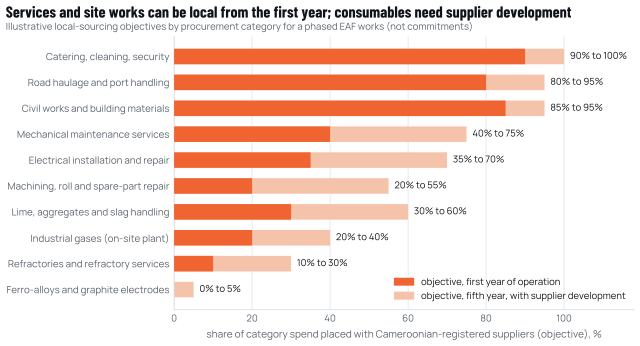
Source: Cameroon Steel analysis. Objectives, not commitments or forecasts; method in Annex A.
6.2 Category by category
The categories in Figure 6.1 differ in what local suppliers need in order to qualify.
- Catering, cleaning and security are labour-intensive services that Cameroonian firms already provide to industry. Qualification is mainly a question of hygiene, safety and labour-law compliance, and of paying staff properly; these services can be almost entirely local from the start.
- Road haulage and port handling are also largely local today, but steel brings heavy and long loads, strict delivery windows and high safety standards for loading and securing. Haulage firms need vehicle standards, driver training and fatigue management to qualify.
- Civil works and building materials can be local if construction packages are sized to the capacity of Cameroonian contractors, and if cement, aggregates and reinforcing steel are bought locally where they meet the specifications.
- Mechanical maintenance and electrical installation require certified welders, electrical authorisations, method statements and quality documentation. They are the categories where supplier development changes outcomes most, and where trained technicians from the plant’s own programmes can create their own firms.
- Machining, roll and spare-part repair need machine tools, metrology and metallurgical knowledge. Douala’s engineering workshops are the starting point; the step up is in precision, documentation and turnaround time.
- Lime, aggregates and slag handling depend on geology and logistics as much as on skills. Steel slag, a by-product, can become a local input for road and construction aggregates, creating a supply chain that runs from the plant outwards.
- Industrial gases, refractories, ferro-alloys and graphite electrodes are specialised, capital-intensive or imported products. Local content in these categories will come first from services, such as operating an on-site oxygen plant or relining furnaces and ladles, rather than from manufacturing.
6.3 Cameroon’s legal framework now ties incentives to local content
Cameroon’s legal framework for local content has been strengthened in three steps since 2023 (Table 6.1). The most important for an industrial investor is Ordinance No. 2025/002 of 18 July 2025 fixing investment incentives, ratified by Law No. 2025/015 of 17 December 2025, which replaced the 2013 investment-incentives law [S36][S37].
The 2013 law it replaced had already listed the iron and steel industry among the priority sectors eligible for specific incentives [S63], and in December 2025 the Prime Minister set up a committee on the integration of mining and metallurgy whose mandate includes the supply of iron ore to local steelmakers [S64]. Under article 6 of the ordinance, any investor seeking incentives must produce "a programme for developing local skills and transferring technology, a plan for the priority recruitment of Cameroonian workers and for priority recourse to local subcontractors and contractors" (Cameroon Steel translation), together with proof that the investment is financed [S36]. Under article 7, a new project must meet at least two of a list of criteria, which include creating direct jobs for Cameroonians at a threshold of at least one job per FCFA 50 million of planned investment, taking local subcontracting into account; for industrial projects, using national natural resources for at least 50% of the value of inputs (excluding labour, water, energy and telecommunications) unless they are unavailable; increasing value added by at least 30%; and exporting at least 25% of turnover [S36]. The ordinance provides for the control of commitments, including the jobs created, and allows the investment convention to be revoked if commitments are not met [S36].
Table 6.1 Cameroonian legal provisions on local employment, skills and suppliers relevant to a steelworks
| Instrument | Provision | What it requires or allows | Source |
|---|---|---|---|
| Ordinance No. 2025/002 of 18 July 2025 (investment incentives), ratified by Law No. 2025/015 | Art. 6(2)(a) | Local-skills and technology-transfer programme; priority recruitment of Cameroonians; priority use of local subcontractors and contractors | [S36][S37] |
| Same | Art. 7 | At least two criteria, including one direct job per FCFA 50 million invested, and for industry 50% national natural-resource inputs | [S36] |
| Same | Control provisions | Verification of commitments, local purchases and jobs created; possible revocation of the convention | [S36] |
| Law No. 2023/014 of 19 December 2023 (Mining Code) | Art. 40(4) | Mining conventions must set the share of production dedicated to local transformation, at least 15% | [S35] |
| Same | Arts. 121 to 123 | Local-content component with a human-resources and a local-enterprise strand; recruitment plan by category; training programme; priority to local SMEs; contribution to a local-capacity development account | [S35] |
| Same | Arts. 124 to 126 | Priority to qualified Cameroonians at equal competence; 95% of posts not requiring particular qualification reserved for Cameroonians; preference for Cameroonian companies; technology-transfer programmes to replace expatriates | [S35] |
| Law No. 92/007 of 14 August 1992 (Labour Code) | Art. 27 | Employment contracts of foreign workers must be approved (visa) by the Minister of Labour before execution | [S33] |
| Finance Law 2023 | Work-visa levy | Two months’ gross salary for non-African workers, one month at half rate for African workers; revenue intended for vocational training | [S30][S31] |
| Finance Law 2025 | Art. 8, "préférence nationale" | Imported goods with locally made equivalents lose customs facilities, with exceptions for trade agreements and certified shortages | [S40] |
Source: as listed. Translations and summaries by Cameroon Steel; the original French texts prevail.
The Mining Code does not apply to a steelworks itself, which holds no mining title. It matters for two reasons. First, its local-content chapter is the most detailed statement of what the Cameroonian State expects from large resource investors, and the same expectations are now generalised by the investment ordinance. Second, it links the ore supply chain to local industry: by requiring that mining conventions dedicate at least 15% of production to local transformation [S35], it creates the legal basis for Cameroonian ore to be processed into iron and steel in Cameroon. Cameroon Steel’s sister company, Cameroon Mining Company, holds the Mbalam exploitation permit [S09].
6.4 Preference is not capability
Legal preference for Cameroonian suppliers solves only half the problem. A preference rule can oblige a buyer to choose a local firm when one is qualified; it cannot make a firm qualified. In heavy industry, the gap is usually in four areas: health and safety systems, quality assurance and documentation, technical capacity for specific tasks, and the working capital to finance contracts paid in arrears. A local maintenance contractor that cannot produce a method statement, a lifting plan or a certified welder will not be allowed on a steel plant site, whatever the law says.
Supplier development closes that gap through a sequence of steps (Figure 6.2). A supplier registers and provides basic legal, tax and safety documents; it is audited for capability and agrees a gap plan; it receives a small, low-risk pilot order under close supervision; it is coached on safety, quality and finance, and paid faster while it grows; it becomes an approved supplier under a framework contract with a performance scorecard; and, at the top of the ladder, it sells to other industries in the zone and the region.
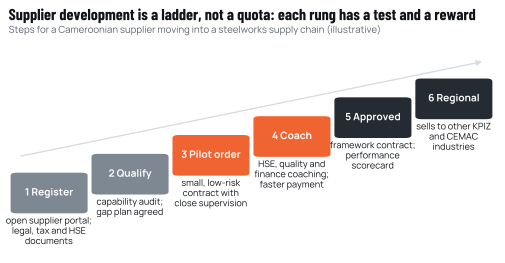
Source: Cameroon Steel proposal.
Each rung combines a test and a reward. The test protects the plant; the reward, a larger order, faster payment or a longer contract, gives the supplier a reason to invest. The two most effective rewards for small Cameroonian firms are often the least expensive for the buyer: predictable volumes, so the firm can hire and train, and payment within agreed terms, so it does not finance the buyer with borrowed money.
6.5 Dangote Cement: local procurement rose while the company reported investing in suppliers
The best-documented African example close to Cameroon’s situation is Dangote Cement, which operates in Nigeria and ten other African countries, including Cameroon [S42]. Its 2025 annual report states that local procurement reached ₦1,719 billion, 82% of total procurement, up from 75% in 2024 and 72% in 2023 (Figure 6.3) [S42]. The share thus rose from 72% to 82% between 2023 and 2025, a period in which the company reports investing in supplier development; the shares are computed on naira amounts, and the effect of exchange-rate changes on them is not separated, so the rise cannot be attributed to supplier development alone. The company describes engaging local small and medium enterprises for quarry services, packaging materials, logistics, catering and facility maintenance across its African operations, and, in Nigeria, supporting haulage operators, block moulders, retailers, artisans and maintenance service providers with capacity-building on health and safety standards, technical training for contractors and mechanics, and stable off-take arrangements [S42].
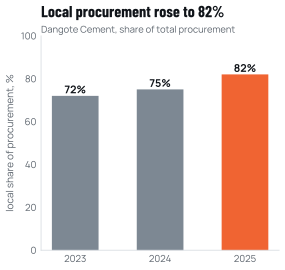
Two points in the Dangote evidence matter for a steelworks. First, local procurement is reported as a share of total spend, year by year, with the method stated in the company’s sustainability reporting; that is the discipline that makes a local-content claim credible. Second, the categories it reports localising are the same as those in Figure 6.1: logistics, catering, facility maintenance and site services, and more technical maintenance. A cement plant is not a steelworks, but its supply chain for services, maintenance and logistics is similar.
6.6 Cameroon already has a supplier base to build on
Cameroon’s steel and metalworking sector is not starting from nothing. Its producers and processors, grouped in professional associations, were reported in May 2026 to account for about 5,000 jobs and about FCFA 500 billion of turnover [S08]. Douala has rolling mills, wire drawers, mesh makers, fabricators and engineering workshops with experience of industrial maintenance. Kribi itself is acquiring an industrial base: the KPIZ zone plans clusters in wood processing and logistics, steelmaking linked to mineral exports, petrochemicals, agro-industry and construction materials [S38], with a first-phase development programme of €400 million out of €795 million planned, to be financed with the African Development Bank, the European Union and the International Finance Corporation [S39].
For a steelworks, these firms are both potential suppliers and potential customers. Fabricators and wire drawers buy bar and rod; machine shops can repair rolls, guides and spare parts; engineering firms can maintain cranes, hydraulics and electrical systems; and construction-materials producers can use steel slag as aggregate, a by-product that a works must find outlets for. A supplier-development programme run at the scale of the zone, rather than of a single plant, would spread the cost of audits, coaching and certification across several buyers and give suppliers a larger market to grow into.
6.7 Measuring local content honestly
Local-content figures are easy to inflate. A purchase from a Cameroonian-registered trading company that imports a finished product counts as "local" in many reports, but it creates few jobs and little value in Cameroon. A credible reporting framework distinguishes at least four measures:
- Spend with Cameroonian-registered suppliers, as a share of total procurement, by category.
- Spend with Cameroonian-owned small and medium enterprises, and with firms based in the South Region.
- Local value added, estimated as the share of each contract’s value that pays for work, materials and services produced in Cameroon.
- Supplier capability outcomes: number of firms audited, coached, approved and certified, and the jobs and training at those firms.
Cameroon Steel’s proposed objectives for the share of spend placed locally are shown in Figure 6.1; Chapter 10 proposes that the cluster publish a common local-content report for the KPIZ zone, using these four measures, so that progress can be compared across employers and over time.
6.8 Risks and how to manage them
Supplier development carries risks that must be managed openly. The first is safety and quality: an under-qualified contractor on a steel plant site is a danger to its own workers and to others, so no local preference should override the safety and quality gates on the ladder. The second is cost: local suppliers may at first be more expensive than imports, and the price difference should be treated as a time-limited development cost with an exit date, not a permanent subsidy. The third is integrity: lists of preferred suppliers attract rent-seeking, so qualification criteria, audit results and contract awards should be documented and auditable, with a grievance channel for firms that are refused. The fourth is dependence: small firms that rely on a single large buyer are fragile, which is another reason to develop them at the scale of the zone and to help them sell to other industries in Cameroon and the Central African region.
Handled in this way, local content becomes what the 2025 ordinance intends: not a quota to be reported, but a channel through which the skills built inside the plant spread into the economy around it.
Other sources cited in the English text
- S37Cameroun: l’Agence de promotion des investissements lance la sensibilisation autour de l’ordonnance de 2025. Droit Médias Finance, 13 May 2026.droitmediasfinance.com/index.php/actualites/droit-ohada-affaires/1260-…
- S632024 Investment Climate Statements: Cameroon. US Department of State, 2024.state.gov/reports/2024-investment-climate-statements/cameroon/
- S64Cameroon reviews metals industry to address supply and energy constraints. Business in Cameroon, 29 Apr 2026.businessincameroon.com/public-management/2904-16094-cameroon-reviews-m…
- S33Loi n° 92/007 du 14 août 1992 portant Code du travail. Republic of Cameroon (FAOLEX copy), 14 Aug 1992.faolex.fao.org/docs/pdf/cmr198304.pdf
- S30« Ces recettes vont assurer le financement de la formation professionnelle ». Cameroon Tribune, 25 Jan 2024.cameroon-tribune.cm/article.html/62720/fr.html/details_2
- S31Cameroun: en 2023, l’État n’a collecté que 5 milliards de recettes auprès des travailleurs étrangers. EcoMatin, 26 Jan 2024.ecomatin.net/cameroun-en-2023-letat-na-collecte-que-5-milliards-de-rec…
- S40Innovations douanières de la Loi de finances 2025. Ministry of Finance, Directorate General of Customs, Jan 2025.minfi.gov.cm/wp-content/uploads/2025/01/EXPOSE_DGD_LF_2025.pdf
- S09Kribi: le Premier ministre, chef du gouvernement est là. Cameroon Tribune, 30 Dec 2024.cameroon-tribune.cm/article.html/68499/fr.html/details_2
- S38Zone industrialo-portuaire de Kribi (KPIZ): jusqu’à +8 points de croissance et 150 000 emplois attendus sur 15 ans. Investir au Cameroun, 4 Mar 2026.investiraucameroun.com/gestion-publique/0403-23163-zone-industrialo-po…
- S39Cameroon launches $860m Kribi industrial zone to process raw materials locally. Ecofin Agency, 27 Feb 2026.ecofinagency.com/news/2702-53326-cameroon-launches-860m-kribi-industri…
本章引用的资料来源
方括号内的标记对应以下来源(按原文语言列出),完整列表见附录。 完整来源列表
- S42Annual Report and Accounts 2025. Dangote Cement Plc,2026年6月.cement.dangote.com/wp-content/uploads/2026/06/Dangote-Cememt-Plc-2025-…
- S08Production: les acteurs en présence. Cameroon Tribune,2026年5月11日.cameroon-tribune.cm/article.html/76600/fr.html/details_2
- S36Ordonnance n° 2025/002 du 18 juillet 2025 fixant les incitations à l’investissement en République du Cameroun (certified copy). Presidency of the Republic (copy published by LEGECAM),2025年7月18日.legecam.cm/wp-content/uploads/2025/08/ordonnance_n_2025_002_du_18_07_2…
- S35Loi n° 2023/014 du 19 décembre 2023 portant Code minier. Republic of Cameroon (FAOLEX copy),2023年12月19日.faolex.fao.org/docs/pdf/cmr223180.pdf
引用本章
Cameroon Steel(2026)。只要培训先于炼钢炉启动,喀麦隆就能为本国钢铁工业培养所需人才(中文摘要版)。白皮书08,第6章:只有培育供应商而不仅是给予优先,本地成分才能放大钢厂的就业效应。CS-WP-08。https://www.cameroon-steel.com/zh/library/skills-for-steel/local-content-and-suppliers/
来源